


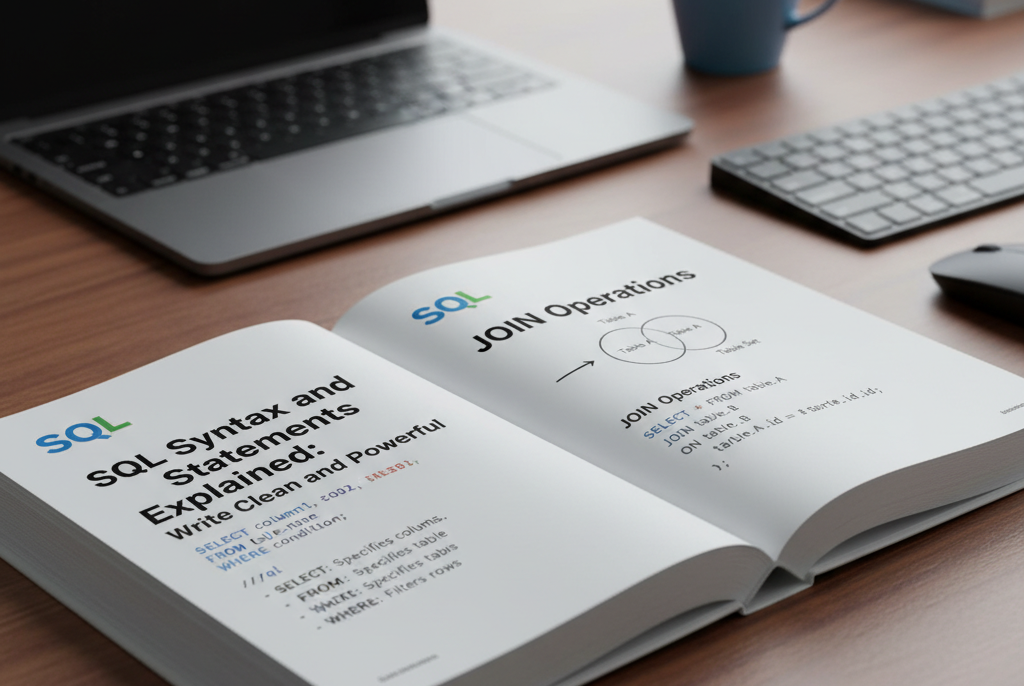
SQL Syntax and Statements explained with simple examples to help beginners write clean, efficient queries used in real-world US business systems.
If you can’t explain it simply, you don’t understand it well enough.
 SQL Syntax and Statements – The Starting Point
SQL Syntax and Statements form the foundation of every database interaction. Whether you are retrieving customer data, updating records, or building data pipelines, understanding SQL syntax is the first step toward working confidently with databases.
In real-world US companies, SQL statements run behind dashboards, reports, billing systems, and analytics platforms every single day.
What Is SQL Syntax?
SQL syntax refers to the structure and rules that define how SQL statements are written. Just like grammar in English, SQL syntax ensures that databases correctly understand your instructions.
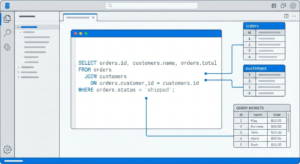
A basic SQL statement usually follows this order:
If the syntax is incorrect, the database will not execute the query.
SELECT column_name
FROM table_name
WHERE condition;
Understanding SQL Statements
SQL statements are commands used to interact with data stored in databases. These statements allow users to:
-
Retrieve data
-
Insert new records
-
Update existing records
-
Delete unwanted data
In SQL Syntax and Statements, commands are broadly categorized based on their purpose.
Types of SQL Statements
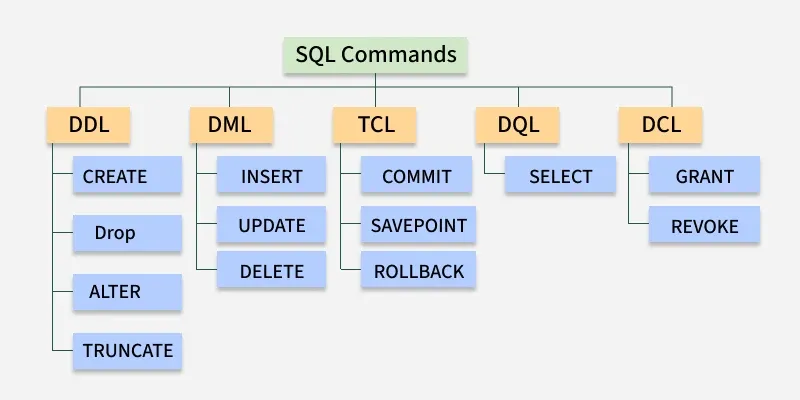
1. Data Query Language (DQL)
Used to fetch data from databases.
Example:
SELECT * FROM customers;
Example:
A US e-commerce company retrieves customer details to display order history in user dashboards.
2. Data Manipulation Language (DML)
Used to modify data.
Common commands:
- INSERT
- UPDATE
- DELETE
Example:
UPDATE orders
SET status = 'Shipped'
WHERE order_id = 1023;
Example:
An online retailer updates order status after shipping confirmation.
3. Data Definition Language (DDL)
Used to define database structures.
Commands include:
- CREATE
- ALTER
- DROP
Example:
CREATE TABLE employees (
  id INT,
  name VARCHAR(100),
  department VARCHAR(50)
);
Example:
A US-based HR system creates employee tables for workforce management.
4. Data Control Language (DCL)
Used to manage permissions.
Example:
GRANT SELECT ON employees TO analyst_role;
Example:
A financial institution restricts data access for compliance and security.
SQL Syntax and Statements in Real-World US Banking
Banks in the US handle millions of transactions daily.
Using SQL Syntax and Statements, banks:
- Retrieve account balances
- Validate transactions
- Generate regulatory reports
- Monitor fraud patterns
SQL ensures speed, accuracy, and reliability in these critical systems.
Why SQL Syntax Order Matters
SQL statements must follow a specific execution order:
- FROM
- WHERE
- GROUP BY
- HAVING
- SELECT
- ORDER BY
Understanding this helps prevent logical errors and improves query performance.
Common Syntax Mistakes Beginners Make
When learning SQL Syntax and Statements, beginners often:
- Forget semicolons
- Misspell keywords
- Use incorrect column names
- Ignore case sensitivity in string values
Careful formatting and validation prevent these errors.
SQL Syntax and Statements in Data Engineering
In data engineering, SQL statements are used to:
- Transform raw data
- Clean invalid records
- Aggregate large datasets
- Load data into warehouses
Tools like Snowflake, BigQuery, and Redshift rely heavily on SQL-based transformations.
🔗Official SQL command reference from MySQL (DoFollow):
https://dev.mysql.com/doc/
Best Practices for Writing Clean SQL Statements
To master SQL Syntax and Statements, follow these practices:
- Use uppercase for SQL keywords
- Write readable and formatted queries
- Add comments where needed
- Avoid unnecessary complexity
Clean SQL is easier to debug and maintain.
Frequently Asked Questions (FAQs)
1. Is SQL syntax the same across all databases?
Mostly yes, but small differences exist between MySQL, PostgreSQL, and Oracle.
2. Do SQL statements run in order written?
No. SQL follows a logical execution order internally.
3. Can I use SQL statements in cloud platforms?
Yes. Cloud data warehouses fully support SQL.
SQL Syntax and Statements are the backbone of every database operation. By mastering SQL syntax early, you build a strong foundation for advanced topics like joins, window functions, and performance optimization.
Our DBS University provides a career focus SQL course which can help to make yourself industry ready.
Clear syntax leads to accurate results—and accurate results drive better business decisions.
0 Comments