


Simplify complex SQL logic using Common Table Expressions (CTEs) to write cleaner, more readable, and maintainable queries for real-world data analysis and reporting.
Readable SQL is maintainable SQL—and CTEs make that possible.
 Introduction to Common Table Expressions (CTEs)
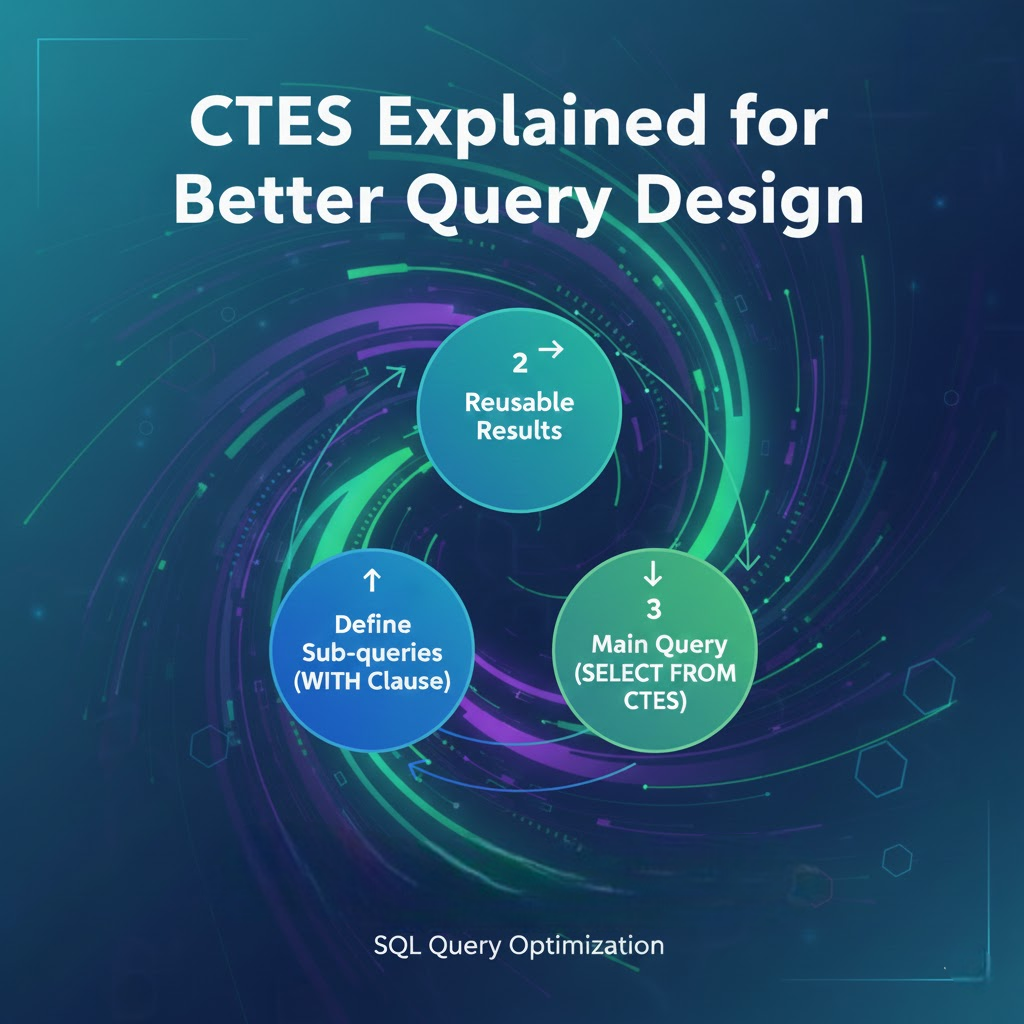
A Common Table Expression (CTE) is a temporary, named result set that you can reference within a SQL query.
CTEs help make complex queries more readable, maintainable, and modular.
CTEs are heavily used in US-based industries such as finance, healthcare, retail, logistics, and data engineering, where SQL queries often involve multiple layers of logic.
What Is a CTE in SQL?
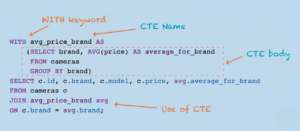
A CTE is defined using the WITH keyword and exists only for the duration of the query.
 Key Benefits
-
Improves query readability
-
Breaks complex logic into steps
-
Replaces deeply nested subqueries
-
Supports recursion
Basic CTE Syntax:
WITH cte_name AS (
SELECT column1, column2
FROM table_name
)
SELECT *
FROM cte_name;

Simple CTE Example:
WITH high_value_orders AS (
SELECT order_id, order_amount
FROM orders
WHERE order_amount > 500
)
SELECT *
FROM high_value_orders;
Example:
A e-commerce company identifies high-value orders for premium customer analysis.
 Using CTEs with Aggregations
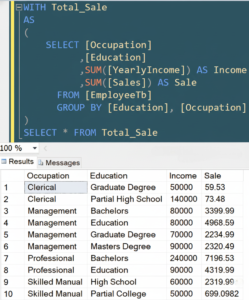
Syntax:
WITH department_avg AS (
SELECT department, AVG(salary) AS avg_salary
FROM employees
GROUP BY department
)
SELECT *
FROM department_avg
WHERE avg_salary > 70000;
In this example, the CTE (Common Table Expression) first calculates aggregated values such as totals or averages. This aggregation logic is isolated inside the CTE, making the query easier to understand and maintain.
The outer SELECT statement then reads from the CTE just like a temporary table. Instead of repeating aggregation logic multiple times, the CTE allows the database to compute it once and reuse the result.
This approach is commonly used in reporting systems, where large datasets (sales, finance, healthcare metrics) require clear and reusable aggregation logic.
Example:
US enterprises use CTEs to analyze department-wise salary trends during budget planning.
Key Benefits:
-
Improves query readability
-
Reduces complexity in large SQL statements
-
Makes debugging and maintenance easier
CTE vs Subquery
| Aspect | CTE | Subquery |
|---|---|---|
| Readability | High | Moderate |
| Reusability | Can be referenced multiple times | Used once |
| Complexity Handling | Better | Harder |
| Debugging | Easier | Difficult |
Best Practice:
Data teams often convert complex subqueries into CTEs for maintainability.
Multiple CTEs in a Single Query
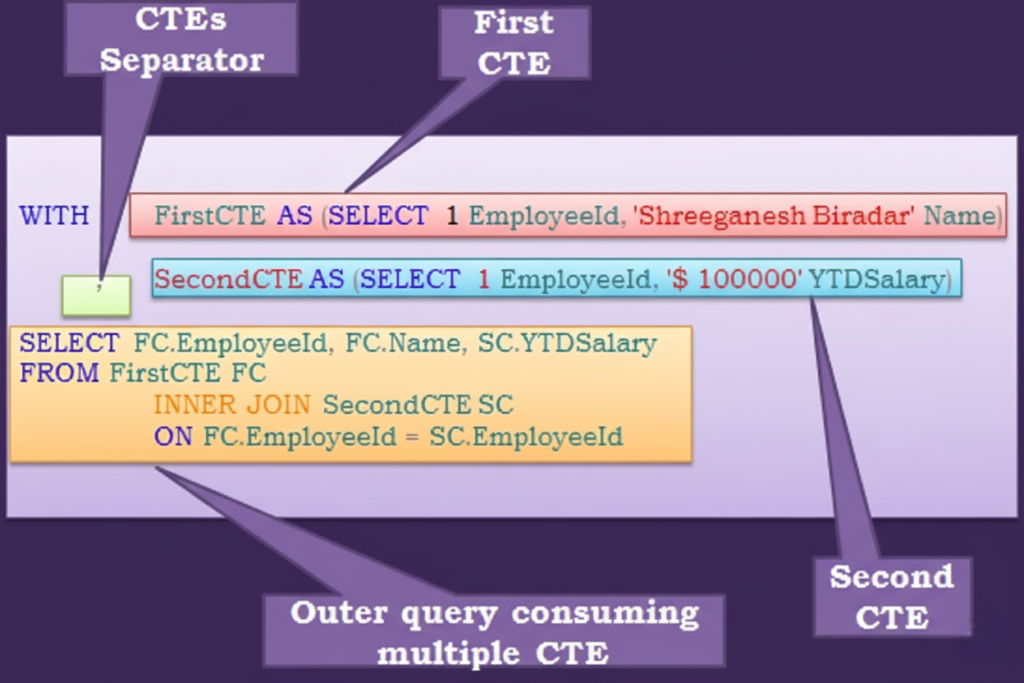
Syntax:
WITH active_customers AS (
    SELECT customer_id
    FROM customers
    WHERE is_active = true
),
recent_orders AS (
    SELECT customer_id, order_amount
    FROM orders
    WHERE order_date >= CURRENT_DATE - INTERVAL '30 days'
)
SELECT a.customer_id, r.order_amount
FROM active_customers a
JOIN recent_orders r
ON a.customer_id = r.customer_id;
Explanation:
In this query, two Common Table Expressions (CTEs) are defined to separate business logic into manageable steps.
The first CTE, active_customers, filters and returns only customers who are currently active.
The second CTE, recent_orders, retrieves orders placed within the last 30 days.
In the final SELECT statement, both CTEs are joined using customer_id. This allows the database to combine only active customers who have placed recent orders, without cluttering the main query.
This pattern is widely used in e-commerce and subscription platforms to track recent customer activity while keeping SQL logic clean and reusable.
Example:
A subscription-based company analyzes recent purchases from active users.
Recursive CTE Explained
Recursive CTEs are used for hierarchical data like organizational charts.

Syntax:
WITH RECURSIVE emp_hierarchy AS (
    SELECT employee_id, manager_id, employee_name
    FROM employees
    WHERE manager_id IS NULL
    UNION ALL
    SELECT e.employee_id, e.manager_id, e.employee_name
    FROM employees e
    JOIN emp_hierarchy h
    ON e.manager_id = h.employee_id
)
SELECT * FROM emp_hierarchy;
Explanation:
The base query selects top-level employees who do not have a manager (for example, CEOs or department heads).
The recursive query then repeatedly joins the employees table to the CTE itself, fetching subordinates for each manager.
This process continues until no more child records are found, effectively building the complete hierarchy.
Example:
US corporations use recursive CTEs to build employee reporting structures.
Real-World Scenario: Financial Reporting
In US finance systems, CTEs are used to:
- Break large reports into steps
- Improve audit readability
- Reuse logic across analytics queries
CTEs improve accuracy and maintainability in regulated environments.
Common Mistakes to Avoid
- Overusing CTEs when simple queries suffice
- Creating very large CTEs without indexes
- Assuming CTEs always improve performance
- Forgetting CTE scope is limited to one query
Best Practices for Using CTEs
- Use clear and meaningful CTE names
- Keep CTE logic focused
- Combine with indexes
- Use CTEs for readability, not blindly for performance
🔗 Official PostgreSQL CTE Documentation (DoFollow):
https://www.postgresql.org/docs/current/queries-with.html
Frequently Asked Questions (FAQs)
1. Are CTEs faster than subqueries?
Not always. They improve readability, but performance depends on the database engine.
2. Can CTEs be reused in the same query?
Yes, a CTE can be referenced multiple times within the same query.
3. Do CTEs store data permanently?
No. They exist only during query execution.
4. Are CTEs used in real production systems?
Yes. They are common in enterprise analytics and reporting systems.
Common Table Expressions make SQL queries cleaner, more readable, and easier to maintain. They are especially useful when working with complex business logic, layered analytics, and hierarchical data.
Our DBS University provides a career focus SQL course which can help to make yourself industry ready.
In enterprise environments, CTEs are widely adopted for financial reporting, data engineering pipelines, and compliance-driven analytics. Mastering CTEs is a critical step toward writing professional-grade SQL.
0 Comments