





Learn SELECT and WHERE Clauses in SQL with simple explanations and real-world US examples to filter, retrieve, and analyze data accurately.
Without data, you’re just another person with an opinion.
 SELECT and WHERE Clauses – The Core of SQL Queries
SELECT and WHERE Clauses are the most frequently used components in SQL. Every time data is retrieved from a database, these clauses decide what data is shown and which records are included.
In US-based companies, SELECT and WHERE clauses power dashboards, reports, customer portals, billing systems, and analytics platforms.
What Is the SELECT Clause?
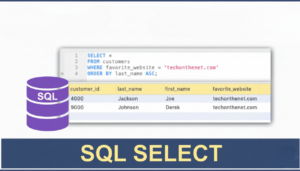
The SELECT clause defines which columns you want to retrieve from a table.
Basic syntax:
SELECT column1, column2
FROM table_name;
Example:
SELECT customer_name, email
FROM customers;
Example:
An e-commerce company retrieves customer names and emails to send order confirmations.
What Is the WHERE Clause?
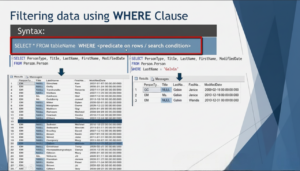
The WHERE clause filters records based on conditions.
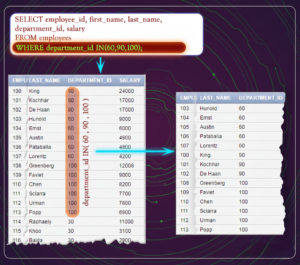
Basic syntax:
SELECT *
FROM table_name
WHERE condition;
Example:
SELECT *
FROM orders
WHERE order_status = 'Delivered';
Example:
A logistics company filters delivered orders for monthly performance reports.
SELECT and WHERE Clauses Working Together
When combined, SELECT and WHERE Clauses allow precise data extraction.
Example:
SELECT order_id, order_date, total_amount
FROM orders
WHERE total_amount > 500;
Example:
A US retail chain identifies high-value purchases for loyalty programs.
Using Comparison Operators in WHERE
Common operators used with SELECT and WHERE clauses include:
| Operator | Description |
|---|---|
| = | Equal to |
| != or <> | Not equal |
| > | Greater than |
| < | Less than |
| >= | Greater than or equal |
| <= | Less than or equal |
These operators help refine data filtering.
Filtering with AND, OR, and NOT
Logical operators enhance WHERE clause filtering.
Example:
SELECT *
FROM customers
WHERE state = 'California'
AND account_status = 'Active';
Example:
A US bank identifies active customers located in California for regional analysis.
Using WHERE with Dates
Date-based filtering is common in business reporting.
Example:
SELECT *
FROM transactions
WHERE transaction_date >= '2024-01-01';
Example:
A finance team retrieves transactions from the current fiscal year.
Handling NULL Values with SELECT and WHERE Clauses
In real databases, not all fields contain values. Missing or unknown data is stored as NULL, and this requires special handling when using SELECT and WHERE Clauses.
Example:
SELECT customer_id, phone_number
FROM customers
WHERE phone_number IS NULL;
Example:
A US telecom company identifies customers without phone numbers to improve contact data quality.
Understanding NULL handling prevents inaccurate query results and reporting errors.
SELECT and WHERE Clauses in Healthcare
Hospitals in the US use SQL daily to manage patient data.
Example use cases:
- Filter patient visits by department
- Retrieve billing records by insurance type
- Identify appointments scheduled for a specific date
SQL ensures accurate and compliant data retrieval.
Common Mistakes with SELECT and WHERE Clauses
Beginners often face these issues:
- Forgetting quotation marks for text values
- Using incorrect column names
- Misusing AND / OR conditions
- Ignoring NULL values
Understanding these mistakes improves query accuracy.
Performance Considerations
Efficient SELECT and WHERE clauses:
- Reduce unnecessary columns
- Filter early to minimize data load
- Improve query speed
This is especially important when dealing with millions of records.
Best Practices for SELECT and WHERE Clauses
To write clean and efficient queries:
- Select only required columns
- Use meaningful conditions
- Format queries for readability
- Avoid using SELECT * in production
These practices are standard in professional SQL environments.
🔗 Official SQL SELECT documentation from PostgreSQL (DoFollow):
https://www.postgresql.org/docs/current/sql-select.html
Frequently Asked Questions (FAQs)
1. Are SELECT and WHERE clauses mandatory in SQL?
SELECT is mandatory for retrieving data, while WHERE is optional but essential for filtering.
2. Can WHERE be used without SELECT?
No. WHERE is always used with SELECT, UPDATE, or DELETE statements.
3. Is SELECT * a bad practice?
It is acceptable for learning, but not recommended for production systems.
SELECT and WHERE Clauses form the backbone of SQL querying. Mastering these clauses enables accurate data retrieval, efficient reporting, and reliable business insights.
Our DBS University provides a career focus SQL course which can help to make yourself industry ready.
Every advanced SQL concept builds upon these fundamentals.
0 Comments