



Avoid data errors and improve query reliability by mastering SQL data types and casting techniques with simple examples and real-world US scenarios.
Clean data starts with the right data type.
 Introduction to SQL Data Types
SQL Data Types define the kind of data that can be stored in a database column.
Choosing the correct data type ensures accuracy, performance, and data integrity.
SQL data types are heavily used in US-based systems such as banking platforms, healthcare databases, retail systems, and government applications, where incorrect data types can lead to serious reporting issues.
What Are SQL Data Types?
A data type specifies:
-
What kind of values a column can store
-
How much space the data occupies
-
How SQL performs calculations and comparisons
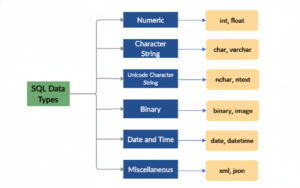
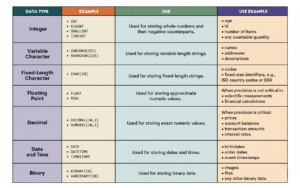
Common SQL Data Types Explained
 Numeric Data Types
Used for numbers and calculations.
| Data Type | Description |
|---|---|
| INT | Whole numbers |
| DECIMAL | Exact precision numbers |
| FLOAT | Approximate decimal values |
Example:
Banks use DECIMAL for financial transactions to avoid rounding errors.
Character and String Data Types
Used to store text.
| Data Type | Description |
|---|---|
| CHAR | Fixed-length text |
| VARCHAR | Variable-length text |
| TEXT | Large text values |
Example:
E-commerce platforms store customer names and addresses using VARCHAR.
Date and Time Data Types
Used for time-based data.
| Data Type | Description |
|---|---|
| DATE | Stores date |
| TIME | Stores time |
| TIMESTAMP | Stores date and time |
Example:
Healthcare systems track appointment schedules using TIMESTAMP.
What Is SQL Casting?
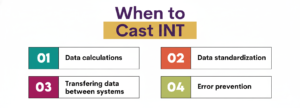
Casting converts one data type into another.
This is useful when SQL needs to compare or calculate values of different data types.
 CAST Function Explained
Syntax:
SELECT CAST(order_amount AS DECIMAL(10,2))
FROM orders;
Example:
A US retail company converts order amounts stored as text into numeric values for accurate revenue calculations.
Using CAST with Dates

Syntax:
SELECT CAST('2025-01-15' AS DATE);
Example:
US government reporting systems convert string-based dates into DATE format for compliance reports
Casting Types in SQL
SQL supports two types of casting: implicit casting and explicit casting.
Implicit Casting
Implicit casting happens automatically when SQL converts one data type to another without being told.
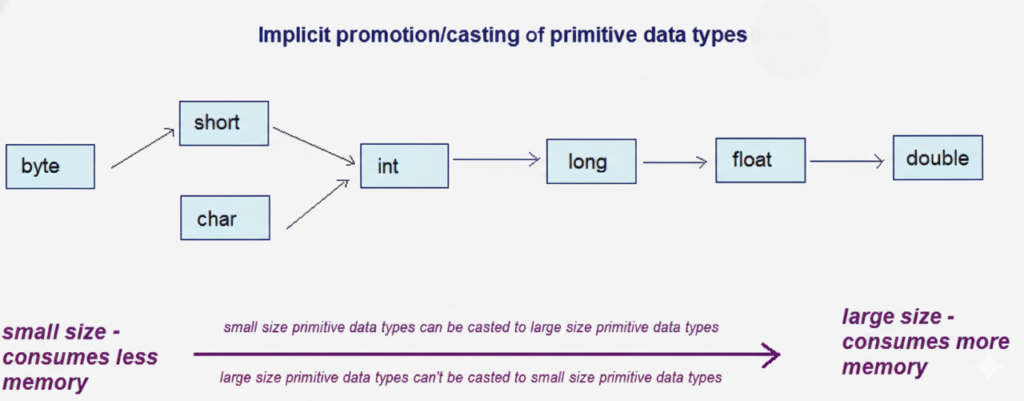
Example:
SELECT 100 + '20';
In some databases, SQL automatically converts '20' to a number.
Industry Note:
Implicit casting can cause unexpected errors in large US enterprise systems. Best practice is to avoid relying on it.
Explicit Casting
Explicit casting is done using the CAST() function and is recommended for production systems.
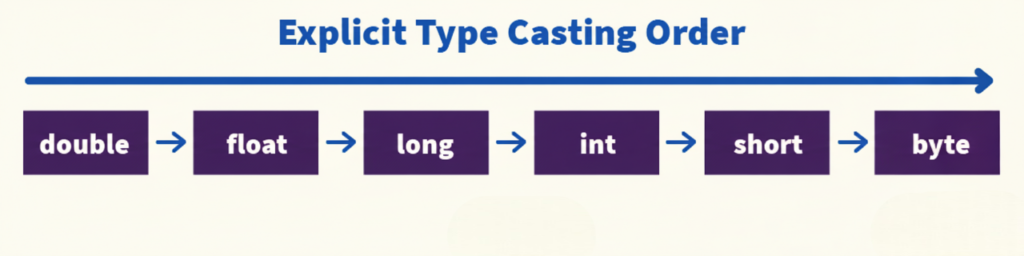
Example:
SELECT 100 + CAST('20' AS INT);
This ensures predictable and reliable results.
Implicit vs Explicit Casting in SQL
| Aspect | Implicit Casting | Explicit Casting |
|---|---|---|
| Definition | SQL automatically converts one data type to another | Developer manually converts data types |
| Control | No direct control by the developer | Full control using CAST() |
| Syntax Required | Not required | Required (CAST() or database-specific functions) |
| Predictability | Can produce unexpected results | Highly predictable and reliable |
| Readability | Less clear to readers | More readable and self-explanatory |
| Error Handling | Errors may occur silently or unexpectedly | Errors are easier to identify |
| Performance Impact | May cause hidden performance issues | Easier to optimize |
| Best Practice | Not recommended for production systems | Recommended for production systems |
| US Industry Usage | Rarely used intentionally | Widely used in US enterprise systems |
Real-World Scenario: Healthcare Data Cleaning
Healthcare systems often receive patient data in inconsistent formats.
 Challenges
- Dates stored as text
- Numeric values stored as strings
- Mixed data formats from different hospitals
Solution
SQL casting is used to:
- Convert patient age to
INT - Convert visit dates to
DATE - Standardize billing amounts using
DECIMAL
This ensures accurate reporting and compliance.
Why Casting Is Important
- Prevents calculation errors
- Ensures accurate comparisons
- Improves reporting reliability
- Supports clean data pipelines
Real-World Scenario: Payroll System
A US payroll system:
- Stores salary as
VARCHAR - Casts it to
DECIMALfor tax calculation - Converts joining dates to
DATE
Casting ensures accurate payroll processing and legal compliance.
Common Mistakes to Avoid
- Using
FLOATfor money values - Ignoring implicit casting issues
- Casting inside large queries without indexes
- Storing numeric data as text
Best Practices for Data Types and Casting
- Always use
DECIMALfor financial data - Choose smallest appropriate data type
- Cast explicitly for clarity
- Validate data before casting
🔗 Official PostgreSQL Data Types Documentation (DoFollow):
https://www.postgresql.org/docs/current/datatype.html
Frequently Asked Questions (FAQs)
1. Why are SQL data types important?
They ensure correct storage, calculations, and query performance.
2. What is the difference between CAST and CONVERT?
CAST is standard SQL; CONVERT is database-specific.
3. Is casting expensive in SQL?
Yes, excessive casting can impact performance in large datasets.
4. Which data type should be used for money?
Always use DECIMAL or NUMERIC.
SQL data types and casting play a crucial role in building accurate, efficient, and reliable database systems. From financial calculations to healthcare reporting, choosing the correct data type and applying proper casting prevents data errors and ensures consistent results.
Our DBS University provides a career focus SQL course which can help to make yourself industry ready.
In US-based production systems, improper data typing is a common cause of performance issues and reporting failures. Mastering data types and casting gives you a strong foundation for advanced SQL development and data engineering roles.
0 Comments